Challenge Accepted: Rethinking Workforce Strategy in a Complex Healthcare Environment
 David Durbin

Why growth, margin, and friction are redefining workforce strategy, and why VMS is more critical than ever
Over the past several weeks, I’ve had the opportunity to spend time with healthcare leaders across the country, executives from large systems, community hospitals, and physician groups.
That included a few days at Becker’s Annual Meeting in Chicago, moving between sessions and quick hallway conversations.
Different organizations. Different roles.
But the conversations have been consistent.
Not simple. Not surface-level. But very clear.
Healthcare organizations are not looking for less structure. They’re looking for less friction.
And that distinction matters.
The Conversation We Should Be Having
Each evening at Becker’s, I shared a quick observation on LinkedIn and always closed the same way:
Challenged Accepted.
Not as a tagline, but because what I was hearing deserved a more complete response.
This is that response.
There’s been a growing narrative in the market suggesting that workforce platforms are becoming obsolete, that the future will be defined by entirely new, simplified models.
It’s an interesting perspective. And it’s rooted in a real problem.
Because the experience in many organizations today is fragmented.
Processes can be manual. Systems don’t always connect. And too often, complexity shows up in the day-to-day work of the people delivering care.
But the conclusion that infrastructure itself is no longer needed doesn’t reflect what healthcare leaders are saying.
If anything, the need for structure is increasing.
I firmly believe that workforce platforms, particularly Vendor Management Systems (VMS), are very much alive.
But they’re evolving.
Health systems, hospitals, and physician groups need platforms to help navigate:
-
More complex workforce models
-
Greater financial pressure
-
Expanding care delivery beyond the hospital
-
Increasing regulatory and compliance demands
The foundation, including governance, visibility, accountability, isn’t going away.
The opportunity is to make that foundation work better.
What Leaders Are Prioritizing
Across every conversation, both formal and informal, three priorities surfaced consistently:
Growth. Margin. And friction.
Growth is being redefined. It’s not just about expanding footprint, it’s about improving access, strengthening physician alignment, and supporting care delivery in the right settings.
Margin is under pressure but remains essential. It enables reinvestment, supports communities, and sustains long-term operations.
And friction is the common thread.
It shows up everywhere.
-
In how work gets requested and approved.
-
In how candidates are sourced and evaluated
-
In how teams communicate and make decisions
-
In the systems meant to support it all
Left unaddressed, friction impacts both growth and margin, and ultimately, the experience of clinicians and patients alike.
When Friction Becomes Financial
Friction doesn’t always show up as a headline issue, but it has a real impact.
A delayed submission process doesn’t just slow hiring; it drives up premium labor costs.
Limited rate visibility doesn’t just create uncertainty; it leads to inconsistent pricing across departments.
Manual workflows don’t just create inefficiency; they slow access to care and frustrate clinicians.
Inaccurate invoicing doesn’t just create administrative burden; it directly affects margin.
Individually, these may seem manageable.
At scale, across a healthcare organization, they compound quickly and become a material financial and operational challenge.
Moving Beyond Fragmented Solutions
One of the challenges in the current landscape is that many solutions are built to address individual problems.
A tool for rate visibility.
A process for managing submissions.
A contract structure for locums.
An approach to invoicing and audits.
Each serves a purpose.
But when they operate independently, the result is often more complexity, not less.
What leaders are asking for, what I heard repeatedly at the Becker’s Annual Meeting, is alignment.
A way to connect these capabilities into a cohesive strategy that:
-
Reduces operational friction
-
Improves financial performance
-
Supports better decision-making across teams
This is where meaningful change happens.
What We Heard and What We’re Doing About It
One thing became very clear in these conversations.
Healthcare leaders aren’t asking for more explanations.
They’re asking, “Who is going to help me navigate this? And what are you doing about it?”
That’s the right question.
And it’s one we’ve been focused on answering.
Not in theory, but in how we’re building and evolving the Trio platform.
Because no two healthcare organizations are the same:
-
Union dynamics
-
Resource pools and timing constraints
-
Physician group strategies
-
Access and growth priorities
This isn’t about adding more features or functionality.
It’s about listening to what our healthcare and agency partners really need.
It’s about responding in a way that reduces friction and improves outcomes across the entire ecosystem.
Building a Platform That Actually Works
Everything we’re doing is grounded in what we’re hearing from our healthcare partners and agencies.
Here is a look at some of the features and functionality that were developed to meet today’s healthcare challenges.
Reducing Friction in Real Time
-
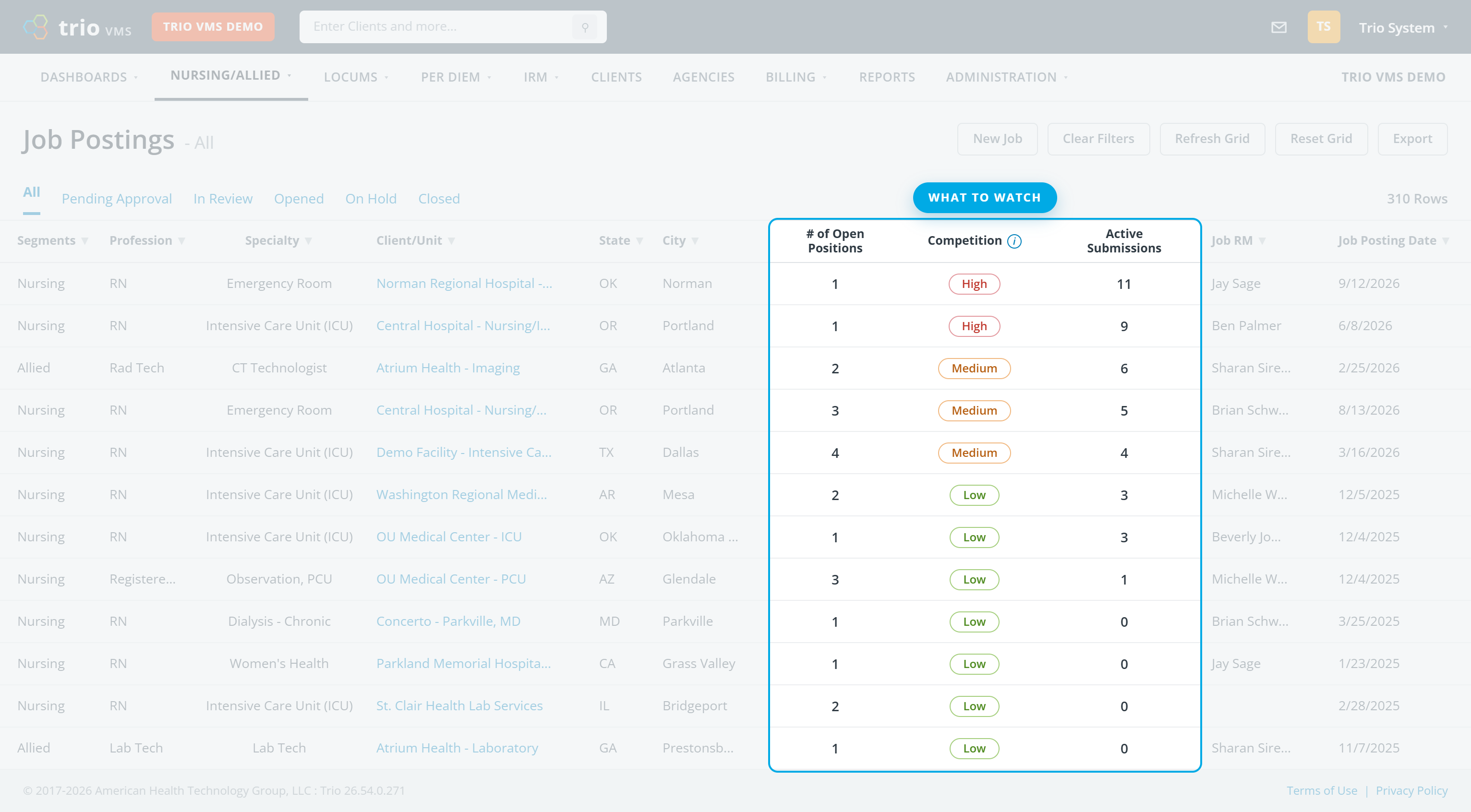
Submission Evaluation provides near real-time feedback and fit scoring, improving candidate quality and reducing back-and-forth
-
Submission Insights gives agencies visibility into job activity so they can focus effort where it matters most
-
Job Description Generation standardizes and improves job quality upfront
These aren’t incremental improvements. It shortens the cycle from request to submission to placement.
Empowering Agencies to Perform at a Higher Level
-
Agency Scorecard creates full transparency into performance, enabling agencies to self-correct and improve outcomes
-
API Improvements and Ask Trio give agencies faster access to the data they need to operate effectively
- Financial Partnership Dashboard provides visibility into performance over time
When agencies are more effective, healthcare organizations get better, faster, and higher-quality submissions.
That connection matters.
Improving Financial Performance and Protecting Margin
-
Timecard Evaluator (Digital Worker) automates auditing and flags exceptions in real time, reducing errors and preventing unnecessary spend
-
Timecard Splitting allows compliant portions to move forward without delay, reducing bottlenecks
This is more than compliance; it’s about protecting the bottom line.
Increasing Visibility Before Decisions Are Made
-
Market Intelligence gives real-time insight into rates and demand, enabling better cost decisions and forecasting
Because making decisions without visibility isn’t strategy, it’s guesswork.
Why This Matters
Individually, each of these capabilities solves a specific problem.
Together, they create something different.
A platform that reduces friction, improves alignment, and helps healthcare organizations make faster, more informed decisions.
And just as important, the platform enables agencies to be more successful, which directly impacts financial and operational outcomes for healthcare organizations.
That’s the ecosystem.
What This Looks Like in Practice
And this is where the conversation shifts.
Because once you connect the dots between friction, margin, agency performance, and visibility, new questions arise.
What ‘s the next step?
What does this look like inside your organization, day to day?
For healthcare leaders, this is already translating into real decisions.
Across organizations, a few practical focus areas are emerging:
-
Reevaluate how workforce decisions are made
Are they reactive and siloed, or aligned to broader financial and access goals? -
Increase visibility before making cost decisions
Without clear insight into market rates and utilization patterns, cost control becomes guesswork. -
Reduce friction at the point of intake and submission
Speed and quality at the front end directly impact fill rates, cost, and clinician experience. -
Audit for accuracy, not just compliance
Small inefficiencies in billing and invoicing compound quickly at scale. -
Align workforce strategy to care delivery shifts
As care moves into outpatient and community settings, staffing models need to follow.
A Different Way to Think About the Role of a Partner
Another consistent theme from the Becker’s Annual Meeting, as challenges become more complex, is how the role of a partner is evolving.
Healthcare organizations today are highly sophisticated.
Leaders understand their challenges.
They’re familiar with the available solutions.
What they’re looking for isn’t basic education, it’s guidance.
Because there is no standardized playbook.
The expectation is partnership, grounded in flexibility, insight, and alignment.
Healthcare leaders want a partner to meet them where they are and help them move forward in a way that aligns with their specific goals.
Why Trust and Neutrality Matter
In that partnership, trust becomes critical.
One of the most important, and often understated factors in building that trust is neutrality.
Leaders need confidence that the recommendations they receive are aligned to their best interests, not influenced by competing incentives.
When neutrality is compromised, the impact is immediate.
Healthcare leaders begin to question:
-
Are we seeing the full market, or a filtered version?
-
Are recommendations aligned to our needs, or to a supplier’s priorities?
-
Are costs being optimized or influenced?
That uncertainty creates hesitation.
And hesitation slows decision-making at a time when speed matters.
Maintaining neutrality preserves the integrity of the relationship, and ensures the focus remains on outcomes.
A Simple Way to Assess Where You Are
As you think about your current workforce strategy, a few questions can help clarify where friction may be impacting performance:
-
Do we have real-time visibility into what we’re paying and why?
-
Are we consistently seeing qualified candidates early in the process?
-
How much manual effort exists between request, submission, and placement?
-
Are we confident in the accuracy of our invoices and spend?
-
Do our workforce decisions actively support growth and access goals?
If the answer to any of these is unclear, there’s likely an opportunity to reduce friction and improve outcomes.
The Work Ahead and the Opportunity Within It
Every conversation I had, at the Becker’s Annual Meeting and beyond, reinforced the same thing.
Healthcare leaders aren’t looking for someone to tell them what their problems are.
They don’t need more noise.
They don’t need more disconnected solutions.
They’re asking for partners who are willing to step into the complexity with them.
To help connect the dots.
To reduce friction.
To protect margin while enabling growth.
That’s what this moment requires.
And for us, that’s what Challenge Accepted means.
It's not a slogan.
Not posturing.
It’s a call to action. It’s a commitment.
Healthcare organizations are navigating one of the most complex environments.
The path forward isn’t about removing structure.
It’s about making it work better.
It’s about aligning systems, simplifying processes, and focusing on what drives meaningful outcomes.
And that’s why workforce platforms, especially VMS, are very much alive and more important than ever.
Because at the end of the day, the goal isn’t the platform.
It’s what the platform enables:
-
Better access
-
Stronger financial performance
-
A more connected experience for clinicians and patients
That’s the work ahead.
And it’s one worth taking on.
Want to See What’s Next?
Interested in seeing how we're continuing to evolve the Trio platform, and what’s coming next?
We’d welcome the conversation.
Just take a few seconds to fill out the form.